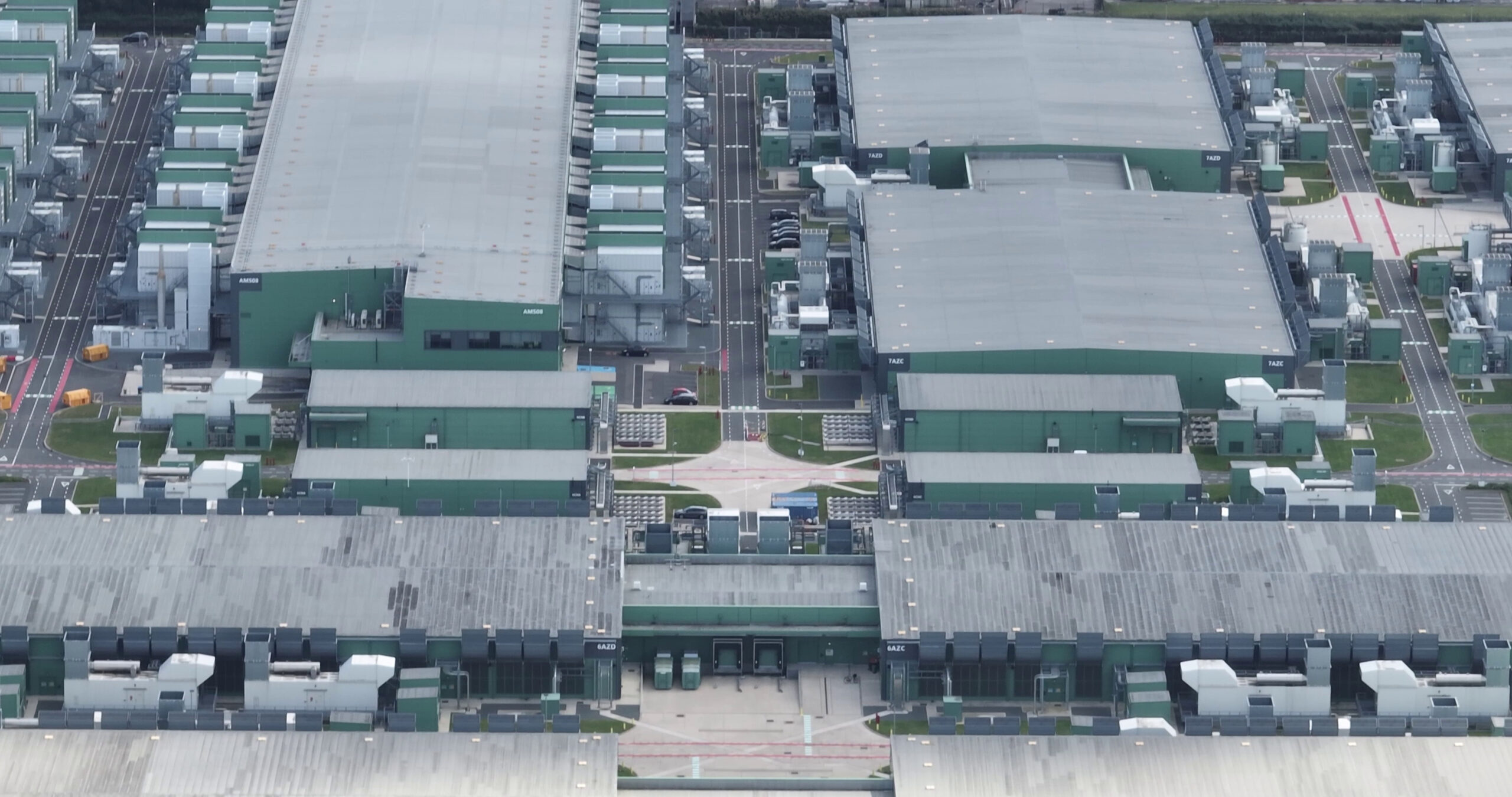
Data center executives are accustomed to tracking Power Usage Effectiveness (PUE) to the second decimal place. They invest in advanced cooling architectures, optimize airflow management, and benchmark against the best hyperscalers in the industry. Yet one of the most consistent drags on cooling efficiency sits entirely outside the building—and outside most efficiency roadmaps. The physical condition and thermal environment of the outdoor HVAC equipment that actually handles the heat rejection.
Cooling already represents a significant share of total data center energy consumption. According to McKinsey’s 2024 research, cooling systems account for approximately 40% of a typical data center’s total facility energy use. A separate analysis by Pew Research Center found that cooling’s share ranges from about 7% at the most efficient hyperscale facilities to over 30% at less efficient enterprise operations. Much of what separates those two ends of the spectrum comes down to how well the physical cooling infrastructure is maintained and protected.
Two specific outdoor degradation factors — solar-driven thermal loading and coil fouling from corrosion and environmental debris — are responsible for a material portion of excess cooling energy consumption and are largely preventable. Understanding and addressing them proactively is one of the most accessible levers for data center operators looking to improve PUE without major capital reinvestment.
How the Outdoor Environment Undermines Data Center Cooling Efficiency
Data center cooling systems — whether centralized chilled-air systems, chilled-water loops, or computer room air conditioners (CRACs) — all share a common dependency. They must reject heat to the outdoor environment. That exchange occurs through rooftop-mounted condensing units, cooling towers, and air handlers. The performance of this equipment is directly affected by the conditions in which they operate.
Solar thermal loading. Rooftop HVAC cabinets and condensing units in direct sunlight regularly reach exterior surface temperatures of 180°F or higher. That temperature is even on days when ambient air temperatures are moderate. The thermal energy transfers into the cabinet interior, raising the temperature of the environment in which the compressor and refrigerant circuit operate. The result is longer run cycles, higher energy draw per ton of cooling delivered, and accelerated mechanical wear. HVAC units are rated under ARI laboratory conditions that do not replicate the real-world rooftop heat load. This means most facilities are operating equipment that performs below its rated efficiency from day one of outdoor deployment.
Coil fouling and corrosion. The heat exchanger coil is the core of any HVAC unit’s efficiency. Over time, exposure to airborne contaminants, humidity, industrial pollutants, and salt or chemical particulates corrodes the coil’s fin-and-tube structure and degrades the fin-to-tube bond that enables efficient heat transfer. Biological fouling adds another layer of blockage. The coil continues to function, but at progressively lower efficiency with more kilowatts consumed per ton of cooling, higher compressor strain, and an accelerating path toward failure. In data center environments, where cooling demand is continuous and mission-critical, this degradation directly erodes PUE.
The Scale of the Problem at a Typical Data Center
The Congressional Research Service has noted that roughly half or more of a data center’s electric power demand stems directly from IT equipment operation. The remainder is going to cooling. For a 100-megawatt facility — a scale increasingly common as AI-driven workloads drive capacity expansion — that means tens of megawatts of continuous cooling load operating around the clock, every day of the year.
Even a modest improvement in cooling system efficiency compounds significantly at that scale. A 10% reduction in cooling energy consumption on a 40MW cooling load represents 4MW of recovered capacity. That is enough to power thousands of additional servers, defer infrastructure expansion, or directly reduce utility expenditure. The industry average PUE remains approximately 1.56, compared with a hyperscale benchmark closer to 1.2, according to the Uptime Institute’s 2024 survey. Closing that gap requires addressing every layer of inefficiency, including the ones that originate outdoors.
ThermalBlock™ (or ThermalBlock by Coat Zone®): Eliminating Solar Heat Load at the Source
ThermalBlock™ (or ThermalBlock by Coat Zone®) is a high-performance radiant barrier coating applied directly to the exterior surfaces of rooftop HVAC cabinets, condensing units, air handlers, and exposed ductwork. It addresses solar thermal loading before it becomes a compressor burden.
Independent testing confirms that ThermalBlock™ (or ThermalBlock by Coat Zone®) blocks up to 93% of solar heat, reducing treated surface temperatures to within 10°F of ambient air even under peak summer solar conditions. It reflects 89% of visible light (ASTM C1549) and rejects 87% of heat gain from external sources (ASTM C1371), achieving a Solar Reflective Index of 108 across varying wind conditions. This is a score that holds up in real-world deployment, not just laboratory baselines. The thermal conductivity of treated surfaces is reduced by approximately 13% (K-Value), while thermal resistance increases by approximately 20% (R-Value).
For data center operators, the operational impact is direct:
- Reduced compressor run time during peak ambient temperature hours
- Lower kWh consumed per ton of cooling delivered
- ThermalBlock™ (or ThermalBlock by Coat Zone®) increases HVAC system longevity by up to 30%
- ROI achievable within 12 to 36 months on minimal capital investment
ThermalBlock™ (or ThermalBlock by Coat Zone®) is applied on-site to both new and existing equipment, with a water-based, low-VOC formulation and a 10-year warranty. This makes it a low-disruption, low-risk upgrade compatible with active operational environments.
CoilSafe®: Protecting the Efficiency Core of Your Cooling System
CoilSafe® is an ultra-thin inorganic coating — just 8 to 10 microns thick, approximately 40 times thinner than standard epoxy coil coatings — applied to HVAC heat exchanger coils to prevent corrosion, restore heat transfer performance, and inhibit biological fouling. Where standard coatings add bulk and can impede airflow, CoilSafe® wicks into the coil’s structure at the molecular level. It retightens the fin-to-tube bond and forms a glass-like inorganic surface that resists moisture, oils, mold, and environmental debris without restricting heat exchange.
The result is a measured 10% improvement in HVAC efficiency (kW/ton), corrosion protection validated through 6,000 hours of salt fog testing (ASTM B117) and 25,000 hours of atmospheric corrosion exposure (ASTM G50), and zero fungal growth in ASTM G21 testing. Because it forms a permanent covalent bond, CoilSafe® will not flake, peel, or degrade — even under sustained environmental stress.
For data center cooling systems operating continuously in environments ranging from coastal humidity to urban industrial air, this level of coil protection directly translates to sustained efficiency over the full service life of the equipment. Rather than the gradual performance erosion that typically goes unmeasured until a replacement event forces the issue.
Proven at Scale: The AT&T Galveston Case
The durability and performance of CoilSafe® is not theoretical. AT&T faced a severe coil corrosion problem at its Galveston Island facility. This area is one of the most corrosive coastal environments in the United States. Constant Gulf of Mexico salt spray was reducing rooftop HVAC coil lifespan to just three to four years. After applying CoilSafe® to new rooftop units at installation, a follow-up inspection nearly eight years later found the coils remained pliable, corrosion-free, and fully functional. The application also delivered a 15% reduction in HVAC energy consumption. This deferred replacement capital and materially improved operating efficiency at a facility where HVAC reliability is non-negotiable.
The AT&T result is instructive for data center operators. In environments with elevated corrosion risk — coastal proximity, industrial air quality, high humidity cycling — the degradation timeline for unprotected coils is measurable in years, not decades. CoilSafe® interrupts that cycle at the point of installation.
A Low-Cost Lever for a High-Cost Problem
Data center efficiency investments tend to focus on IT hardware, power distribution architecture, and advanced cooling system design. All of which involve significant capital commitment and planning cycles. ThermalBlock™ (or ThermalBlock by Coat Zone®) and CoilSafe® represent a different category of investment. That is, protective coatings applied to existing equipment that recover efficiency being lost to entirely preventable physical degradation.
The combination of reduced solar heat loading and restored coil performance addresses the two primary outdoor-environment contributors to cooling inefficiency, with ROI timelines that compare favorably to virtually any alternative efficiency measure under consideration. For data center executives focused on PUE improvement, sustainability commitments, and operational cost management, these coatings belong in the efficiency conversation.
Contact Coat Zone® to learn how ThermalBlock™ (or ThermalBlock by Coat Zone®) and CoilSafe® can be integrated into your facility’s efficiency strategy.
Citation List
- Pew Research Center. “What We Know About Energy Use at U.S. Data Centers Amid the AI Boom.” October 24, 2025. pewresearch.org
- Congressional Research Service. “Data Centers and Energy: CRS Report R48646.” congress.gov/crs-product/R48646
- Hanwha Data Centers. “Data Center Energy Efficiency Best Practices: 11 Tips from Top Operators.” October 10, 2025. hanwhadatacenters.com
- The Network Installers. “Data Center Energy Consumption Statistics & Data (2026).” January 12, 2026. thenetworkinstallers.com
- Etalytics. “IEA Energy Efficiency Report 2025: Data Center Cooling.” December 18, 2025. etalytics.com